The sound of a dental drill indicates that your Oakbrook Terrace dentist is restoring your oral health and enabling you to bite and chew with ease. And even though that familiar sound may cause anxiety in some, Dr. Ayesha Khan understands your fears. She offers patience and proven techniques to help you feel at ease and alleviate your concerns.
January 26 is Dental Drill Appreciation Day, giving us a chance to highlight the importance and effectiveness of this remarkable device.
So, let’s explore why we celebrate Dental Drill Appreciation Day and learn more about how the dental drill has changed over time.
What Is Dental Drill Appreciation Day?
On January 26 of each year, we take a moment to highlight how the dental drill has transformed dentistry, providing pain relief and restoring functionality. This essential instrument isn’t just a mechanical device; it’s a way for dentists to help their patients feel more confident and keep their teeth healthy for a lifetime.
Many people cringe at the sound of a dental drill, but this special day is designed to normalize your dental experience and highlight what this tool can do for your smile and oral health.
The History and Significance of Dental Drill Appreciation Day
Dental drills have been around for centuries, with early versions dating back to ancient civilizations. Flint or metal tools were used to remove tooth decay, a process that was painful and often ineffective.
Then, in the 19th century, the first foot-powered dental drill was invented. This innovative tool used a foot pedal to rotate a handpiece, making dental procedures more efficient than ever before.
By the mid-20th century, the electric dental drill was invented, giving dentists better control over treatment outcomes. There was no longer a need for a foot pedal, so treatments were faster and more effective. Dentists were finally able to provide comfortable care.
In the late 20th and early 21st centuries, high-speed dental drills became available, capable of rotating at more than 400,000 RPM, enabling dentists to remove decay quickly and effectively. Water spray was added to cool the drill bit and improve comfort.
Laser dentistry is increasingly replacing traditional drilling; this non-invasive treatment option can preserve more tooth structure and minimize bleeding and discomfort. This remarkable technology can be used for numerous dental concerns.
How Does a Dental Handpiece Work?
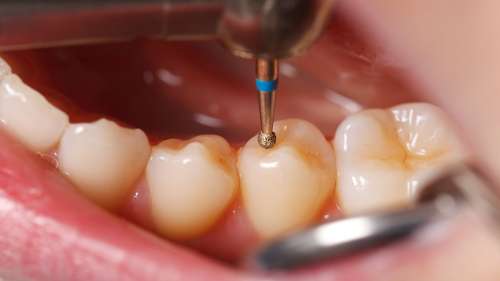
Modern dental drills use electricity to rotate a drill bit at high speeds. This fast rotation allows us to effectively remove decayed tissue and prepare your tooth for a filling. The drill bit is made from durable materials such as diamond or tungsten carbide so that it can withstand tremendous force.
Today’s dental drills also have attachments for different dental procedures. That way, we can drill through enamel and dentin with one drill bit or use a different bit for polishing your tooth.
Regardless of what procedure you need, we hope you understand how the modern drill makes your dental visit more comfortable and efficient.
So, the next time you hear that familiar sound, think about what a fantastic innovation it is and be thankful for the modernization of the dental drill!
The Wand® Anesthesia System: Providing More Comfortable Care
Another way we keep patients more comfortable and reduce their anxiety is with our computer-assisted anesthesia system. Without a syringe, we can numb your mouth and provide pain-free treatment without any grogginess or anxiety.
Click here if you’d like to learn more about this innovative system.
Need a Dentist in Oakbrook Terrace, IL?
If so, Dr. George Rivera and Dr. Ayesha Khan would love to hear from you! Dr. Ayesha Khan, DMD, offers a welcoming approach to dental care and is especially adept at helping patients overcome dental anxiety.
To schedule an appointment, please feel free to reach out to us at (630) 592-4949.